I should have titled this "What happens when you get out of the way of your students and let them create." Here's what resulted when I stepped aside and simply encouraged my students to create.
As part of the Senior Experience program at Cal State San Marcos, my five students were tasked with building awareness and increasing outreach for the Temecula campus of CSUSM. While their project included many more deliverables than this, the students took it upon themselves to go further and deliver additional value to the client. Here's what they came up with as their "One More Thing" (à la Steve Jobs) to the client's delight.
Share your comments on YouTube or in the space below.


Indication of a good day as an entrepreneurship professor
Today has been a good day for two very important reasons:
 1. I received by express mail the next product iteration from one of the entrerpreneurs (and CSUSM alums) with whom I keep in close contact, Erik Groset at Zipbuds. These guys at Zipbuds never stop innovating. The newest Zipbuds keep all of what was good of the past generations of 'buds (crystal-clean audio quality, tangle-free zippered design, personality-exhibiting bold color choices) and add some new features that have significantly upped the wow factor. It's not my place to disclose what those features are, but suffice it to say that if you already own a products from the Zipbuds family, you'll likely find your mouth agape when you see this next gen product. Erik, when are they going to be released to the rest of the world? [Yes, I'm lucky to have been able to put these through their paces before they're on the market.]
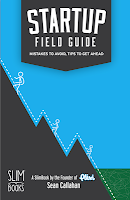 2. I am pleased to share that another one of our CoBA alums and former students of mine, Sean Callahan, just shared with me that his entrepreneurial lessons-learned book was published today. Check it out at Amazon. With only a few minutes into it and I've already come across some familiar concepts and beliefs from my own teachings in Entrepreneurship. His writing is clear and his insistence on the practical aspects of launching a startup is refreshingly down to earth.
I continue to be so proud of both of these guys and their verifiable efforts in "making something from nothing!" Keep up the great work.
 1. I received by express mail the next product iteration from one of the entrerpreneurs (and CSUSM alums) with whom I keep in close contact, Erik Groset at Zipbuds. These guys at Zipbuds never stop innovating. The newest Zipbuds keep all of what was good of the past generations of 'buds (crystal-clean audio quality, tangle-free zippered design, personality-exhibiting bold color choices) and add some new features that have significantly upped the wow factor. It's not my place to disclose what those features are, but suffice it to say that if you already own a products from the Zipbuds family, you'll likely find your mouth agape when you see this next gen product. Erik, when are they going to be released to the rest of the world? [Yes, I'm lucky to have been able to put these through their paces before they're on the market.]
I continue to be so proud of both of these guys and their verifiable efforts in "making something from nothing!" Keep up the great work.
Hitching Your Wagon to a Star
I presented this Prezi at the Hawaii International Conference on System Sciences held at the Grand Wailea, Maui in January 2013. Click on through it, if you're interested...and let me know what you think of it.
In this presentation, I highlight three IT-based entrepreneurial startups and discuss how each have hitched their wagon to a tech star. The founders of the exemplar startup, TweetPhoto (turned Plixi, acquired by Lockerz), made key moves early in their launch that enabled the firm to grow quickly and overcome the first-mover advantages of their quicker-to-market competitors. In the final two startups, I encourage the reader to discover how two Instagram-linked startups, Instacanvas and Instapparel, are currently hitching their wagon to Instagram's star.
As you might imagine, the case presentation is better heard than clicked through, so if you'd like to learn more about the teaching case and how I use it in my teaching and research, please contact me via LinkedIn, Twitter, or email.
You've Welcomed Me, You've Taught me
I've been fortunate to have met dozens of entrepreneurs over the past six years. While I'm employed as an educator, you have certainly been the educator to me. Here's what I've learned from my interactions with you, the entrepreneur:
- you don't accept the status quo
- you believe in a better way
- you work tirelessly on your craft
- you created something from nothing
- you are a nobody to the customers who don't yet know you or your business, yet
- you are a somebody to the somebodies that really matter (family, friends, customers that now know you)
- you recognize that the world is constantly changing around you and you adjust
- you try, test, revise...every day
- you recognize the value of business plans, but you didn't have one before you started your successful multi-million dollar business
- you looked past the naysayers
- you believed in your idea not because it was your idea, but because it was a really good idea; anyone would see that if they just looked at it
- you don't allow stereotypes of you or anyone else to trip you up; you focus on what matters and nothing else
- you harnessed your creativity
- you expected curiosity to count for something more than just an idle, lifeless thought
- you're not a critic, a cynic, nor an arm-chair quarterback*
- you are an adventurer, an explorer, and a doer of this world*
- you took a step off the Edge of Entrepreneurship and life's never been the same ever since
your bottling facility,
your factory,
your lab,
your studio,
your warehouse,
your office
and I've been changed because of it. Thank you for allowing me to glimpse inside your entrepreneurial mind. It's a fascinating place.
*paraphrased from "Message to Future Generations" by Lt. Col. Ellison Onizuka who tragically died aboard the Space Shuttle Challenger in 1986. These words are found at the Kona International Airport in Hawaii.
Learning from Steve Jobs
 It's been a few days now since Steve Jobs passed away and his legacy continues to occupy my thoughts throughout my week.
 I recently watched the video of his memorial service from Apple's Cupertino campus and wanted to share a few items with you, in the hopes that you'll be encouraged by this.
The service began with a moving introduction from Apple CEO, Tim Cook. While all of his remarks were worth hearing, I highlight the most poignant and profound below:
I personally admire Steve not most for what he did, or what he said, but for what he stood for. The largest lesson I learned from Steve was that the joy in life is in the journey, and I saw him live this every day.Steve never followed the herd. He thought deeply about almost everything and was the most unconventional thinker I have ever known. He always did what he thought was right, not what was easy. He never accepted the merely good. He would only accept great—insanely great.He valued beauty in everything, and insisted that everything that Apple do be beautiful. He believed the future does not belong to those who are content with today, and pushed himself incredibly hard and those around him to achieve more. This is the way he lived, and these are the things he leaves us. What he did, what he said, and what he stood for.But there is one more thing he leaves us. He leaves us with each other because without him, Apple would have died in the late 90s and the vast majority of us would have never met. Other than his family, Apple would be his finest creation. He thought about Apple until his last day, and among his last advice he had for me and for all of you was to never ask what he would do. "Just do what's right," he said.
The service included music by Norah Jones and Coldplay. The standout performance was Jones' "The Nearness of You" (at 23:40). Her voice and piano sounded like a studio recording, but were live and all too thoughtful given the occasion. Truly moving stuff there.
I also appreciated the measured, but warm, memories from Jony Ive who spent immeasurable hours with Steve as they developed products over the past decade. Watch at 48:30.
He used to joke that the the lunatics are taking over the asylum...as we shared a giddy excitement spending months and months working on a part of a product that nobody would ever see. We did it because we thought it was right and because we cared. He believed that there was a gravity, almost a sense of civic responsibility, to care way beyond any sort of functional imperative.Now while the work hopefully appeared inevitable, appeared simple and easy, it really cost. It cost us all, didn't it. But, you know what? It cost him the most. He cared the most. He worried the most deeply, he constantly questioned 'is this good enough? is this right?' And despite all his successes, all his achievement, he never presumed, he never assumed that we would get there in the end. When the ideas didn't come and when the prototypes failed, it was with great intent with faith, he decided to believe we would eventually make something great.But, the joy of getting there. I loved his enthusiasm. His simple delight, often I think mixed with some relief, that yah we got there, we got there in the end and it was good. You can see his smile, can't you? The celebration of making something great for everybody. Enjoying the defeat of cynicism, the rejection of reason, the rejection of being told a hundred times, you can't do that. So, his I think was a victory for beauty, for purity, and as he would say, 'for giving a damn.'He was my closest and my most loyal friend. We worked together for nearly 15 years...This morning, I simply want to end by saying Thank You, Steve. Thank you for your remarkable vision which has united and inspired this extraordinary group of people.
Jony's remarks reminded me of something else I read today. As many of you know, today marks the release date for his biography, authored by Walter Isaacson. According to Isaacson (as shared on CBS News), much of Steve's relentless attention to detail and inherent quality can be traced back to his upbringing. According to Isaacson,
Paul Jobs was a salt-of-the-earth guy who was a great mechanic. And he taught his son Steve how to make great things. And he--once they were building a fence. And he said, "You got to make the back of the fence that nobody will see just as good looking as the front of the fence. Even though nobody will see it, you will know, and that will show that you're dedicated to making something perfect."
If you have a moment to watch the entire service, you should. If you can't find the time, at least click forward the video to 11:15-12:24 and listen in. I'll bet that will stick with you for some time. If it doesn't, then you're likely not one of the crazy ones.
Creative Thinking, by Michael Michalko

[This article is an excerpt from Creative Thinkering, a book that I've been reading lately. I asked the author if I could include it on my blog as part of my guest author series. He agreed. I hope you enjoy reading his thoughts on intention boards.]
Guest Author: Michael Michalko, bestselling author of Thinkertoys
Experimental social psychologists have conducted numerous experiments that demonstrate how behavior and performance can be “primed” by showing participants certain objects and pictures. In one study, participants who were primed with pictures associated with business — such as briefcases, pens, pictures of people dressed in business clothes, commuter trains, and so on — became more competitive. The social psychologist Michael Slepian and colleagues at Tufts University noticed during a study on “bright ideas” that participants became more insightful and creative when they were primed with an exposed lightbulb. In short, they found that even exposure to an illuminating lightbulb primes creativity.
One way to prime yourself for creativity is to generate an awareness of what you want to be or accomplish. You can do this by creating an “intention board.” An intention board is a large poster board on which you paste images, sayings, articles, poems, and other items that you’ve collected from magazines and other sources. It’s simple. The idea is to surround yourself with images of your intention (what you want to create or who you want to become) and, in the process, to encourage your awareness and passion to grow. Lay your intention board on a surface where you can work on it, and try out this thought experiment:
Ask yourself what it is you want to be or to create. Maybe one word will be the answer. Maybe images will appear in your head. Post the word or image in the middle of your intention board.
Suppose you want to create a new business. Post the words “New Business” or a picture that represents a new business in the center of the board. Now look through magazines and other sources and pull out pictures, poems, articles, or headlines that relate to entrepreneurs and new business ventures. Have fun with it. Make a big pile of images, words, and phrases. Go through the pile and put favorites on the board. If you add new ones, eliminate those that no longer feel right. This is where intuition comes in. As you place the items on the board, you’ll get a sense how they should be laid out. For instance, you might want to assign a theme to each corner of the board, such as “What I have,” “What I will have,” “What I need,” and “How to get what I need.”My brother-in-law desired to be an artist. His intention board was a collage of pictures of paintings and artists, poetry about art, and articles about artists and their work. Over time, he began to imagine conversing with his various prints of paintings. One print that particularly enthralled him was Vincent van Gogh’s Starry Night. He would focus on the painting and engage in an imaginary two-way conversation. The more he engaged with the painting, the more alive it seemed to become. He would ask the painting questions, such as, What inspired the artist to paint the picture? What was his knowledge of the world? What were his contemporaries’ views of the painting? How was the artist able to communicate over the centuries? What is the artist communicating? He would ask how the colors worked together, and ask questions about lines, shapes, and styles.
Hang the board on a wall and keep adding new pieces that you feel have more relevance and removing those that no longer work. Study and work on it every day. You’ll discover that the board will add clarity to your desires, and feeling to your visions, which in turn will generate an awareness of the things in your environment that can help you realize your vision.
My brother-in-law, once a disgruntled government employee, is now a successful artist who has had several showings of his work, at which he sold pieces. He created an environment with his intention board that influenced his insight into art and his role in the world. The board primed his subconscious mind, which influenced his psychology.
Imagine a person who is aware of all the colors “except one particular shade of blue. Let all the different shades of blue, other than that one, be placed before him, arranged in order from the deepest to the lightest shade of blue. He most probably will perceive a blank, where that one shade is missing,” and will realize that the distance is greater between the contiguous colors than between any others. He will then imagine what this particular shade should look like, though he has never seen it. This would not be possible had he not seen all the different shades of blue.
Similarly, as your board evolves and becomes more and more sophisticated, you will perceive blanks where something is missing. You will then begin to imagine ways to fill in the blanks in order to realize your vision.
Your brain becomes an extraordinary pattern-recognition tool when you focus your intention. In addition to identifying what’s missing, you will begin to think of alternatives that can substitute for what is “missing” from your intention board. You will find yourself seeing more than what is there.
MICHAEL MICHALKO is the author of Creative Thinkering, Thinkertoys, Cracking Creativity, and ThinkPak. While an army officer, he organized a team of NATO intelligence specialists and international academics to find the best inventive thinking method. He has expanded and taught these techniques to numerous Fortune 500 companies and organizations. He lives in Rochester, New York. Visit him online at http://www.CreativeThinking.net.
Excerpted from the book Creative Thinkering: Putting Your Imagination to Work ©2011 by Michael Michalko. Printed with permission of New World Library, Novato, CA. www.newworldlibrary.com
Who is the Mother of Invention?
Oh, yes, I now remember that Necessity is the Mother of Invention. Sorry, Plato, I had to borrow your quote here as I was reminded today by a former student that simple innovations are often the best innovations. See for yourself by watching this short video.
Subscribe to:
Posts (Atom)